
Monday, March 8, 2010
March 8-12: Tectonic Test & Abiotic/Biotic Factors
Students will be tested on the plate tectonic unit that we've been working on this Wednesday (March 10). Please help your students to study - ask them about the different types of boundaries, and how plate tectonics affects the other parts of Earth's system (for example, how do mountains affect the atmosphere, the biosphere, the hydrosphere, etc.). They also need to understand Wegener's theory of continental drift, the evidence for it, and how that theory has changed with increasing technology (we can actually see the tectonic plate boundaries from space!). This unit has come at a unique time of history where we've experienced some pretty serious earthquakes. Students should be able to explain to you what happened in the last Chile earthquake.
 At the end of the week, we will move on to a new topic. Here at the end of the quarter we will be discussing ecology - and we'll start with biotic and abiotic factors that influence different ecosystems.

Monday, March 1, 2010
March 1-5: More on Plate Tectonics
Ironically, this week we will be discussing plate tectonics and the interactions of the plates that make up the crust of the Earth. Hopefully we will be able to tie in the recent events in Haiti and Chile to help students understand what is happening - and to show what an impact geology has on living things. Students will be working on pages 17, 18, and 19 in their notebooks this week. They will also be tested on this material sometime next week (just a heads up).
To look at plate dynamics, students will be making observations about where volcanoes and earthquakes are most common. They will also be doing an "Oreo Lab" to look at the different interactions of the plates.
I appreciate all of you who were able to come to student-led conferences, especially those who came to chat with me. Often students get into a 3rd quarter slump - please help them stay driven during these last few weeks of winter.
To look at plate dynamics, students will be making observations about where volcanoes and earthquakes are most common. They will also be doing an "Oreo Lab" to look at the different interactions of the plates.
I appreciate all of you who were able to come to student-led conferences, especially those who came to chat with me. Often students get into a 3rd quarter slump - please help them stay driven during these last few weeks of winter.
Thursday, February 18, 2010
Feb 15-19: Presentations & layers of the Earth
 As many of you parents probably know because you've had to help your kids, the students have been presenting PowerPoints that they have made about a marine animal of their choice. The most important part of the presentation was to realize what amazing adaptations animals have in order to live in the ocean environment (how they deal with salinity, cold temperatures, pressure, etc.). These are called abiotic factors (things that affect living organisms, but that are not alive - that's what abiotic means). Depending on how quickly students work through the presentations, some classes will start a small project on the layers of the Earth. They will make a foldable - a fun way to present information and keep it organized.
Friday, February 12, 2010
Feb. 8-12: Test & Marine Animal Research
Students took a test this week on water. It covered both freshwater properties and ocean properties (waves, tides, El Nino, etc.). For the last half of the week, students have been making PowerPoint presentations about an ocean animal. They had to give a description, a food chain, the adaptations the animal has to abiotic factors (non-living factors like temperature, water pressure, salinity, etc.), and they had to find 3 interesting facts that no one will already know about the animal. They will be presenting on Tuesday. Unfortunately, many of our mobile lab computers that students have been using and working on are pitifully slow and don't work very well. I will be emailing some of their projects to their personal email accounts so that they can finish their project over the weekend. Please help them email it back to me, or get it onto a flash drive. Thanks!
Monday, February 1, 2010
Sea Level Change Websites
Click on the links to go to the following websites to learn about sea level changes:
Map: pubs.usgs.gov/circ/c1075/images/sea.gif
NYC Article: www.oar.noaa.gov/spotlite/archive/spot_nycplanning.html
Arctic Indicators: www.arctic.noaa.gov/detect/index.shtml
Florida Coast: www.geo.arizona.edu/dgesl/research/other/climate_change_and_sea_level/sea_level_rise/florida/slr_usafl_a.htm
USA Coast: www.geo.arizona.edu/dgesl/research/other/climate_change_and_sea_level/sea_level_rise/north_america/slr_north_america_a.htm
Map: pubs.usgs.gov/circ/c1075/images/sea.gif
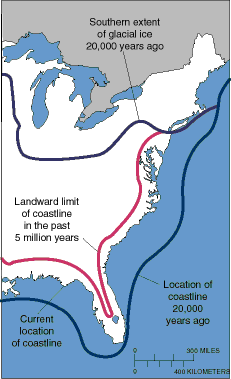
NYC Article: www.oar.noaa.gov/spotlite/archive/spot_nycplanning.html
Arctic Indicators: www.arctic.noaa.gov/detect/index.shtml
Florida Coast: www.geo.arizona.edu/dgesl/research/other/climate_change_and_sea_level/sea_level_rise/florida/slr_usafl_a.htm
USA Coast: www.geo.arizona.edu/dgesl/research/other/climate_change_and_sea_level/sea_level_rise/north_america/slr_north_america_a.htm
Thursday, January 28, 2010
Jan. 25-29: Oceans
At the beginning of the week students worked on a large sea water lab where they learned about salinity, water pressure, and the formation of convection currents. For the latter half of the week we'll be doing formal notes on these sea water properties, and we will start talking about ocean dynamics (currents, tides, etc.). To look more closely at ocean currents, students will be doing an activity where they trace the path of some Nike shoes that were lost in the ocean in 1999 and are still circling the globe today because of these currents.
Students were given their Quarter 2 report cards this week, so you should be seeing them at home. They have also been given a new weekly check-in log for this class (bright green). Week 1 should be crossed out because I was too slow, so this is Week 2.
Students were given their Quarter 2 report cards this week, so you should be seeing them at home. They have also been given a new weekly check-in log for this class (bright green). Week 1 should be crossed out because I was too slow, so this is Week 2.
Thursday, January 21, 2010
Jan. 18-22: Finish Freshwater
We're finishing our discussions about freshwater this week. We'll finish taking notes about the reservoirs where water is found here on Earth (atmosphere, groundwater, icecaps, and oceans), we'll do a mini-lab about the properties of water (cohesion, adhesion, and dissolving power), and we'll make up any work that was missed last week. I was sick last week, so here's what they should have done: made new notebooks, read and discussed water conservation possibilities, read and discussed about water quality indicators, and read articles about pollution found in our local area. LOTS of reading...sorry... but it's hard to come up with more active things for subsitutes to do with a class of students they don't know.
Speaking of substitutes... unfortunately, my three 9th grade classes gave the substitute the hardest time. Please remember how to behave when there is a guest in our room. I expect better in the future!
Speaking of substitutes... unfortunately, my three 9th grade classes gave the substitute the hardest time. Please remember how to behave when there is a guest in our room. I expect better in the future!
Subscribe to:
Posts (Atom)